Higher BTO, singles and EC income ceilings will open the door to more Singapore households. But qualifying for more housing options does not automatically mean you should buy them. Here is what changed — and, more importantly, how we think buyers should respond.

At National Day Rally 2026, Prime Minister Lawrence Wong announced several significant housing changes.
The headline numbers are straightforward:
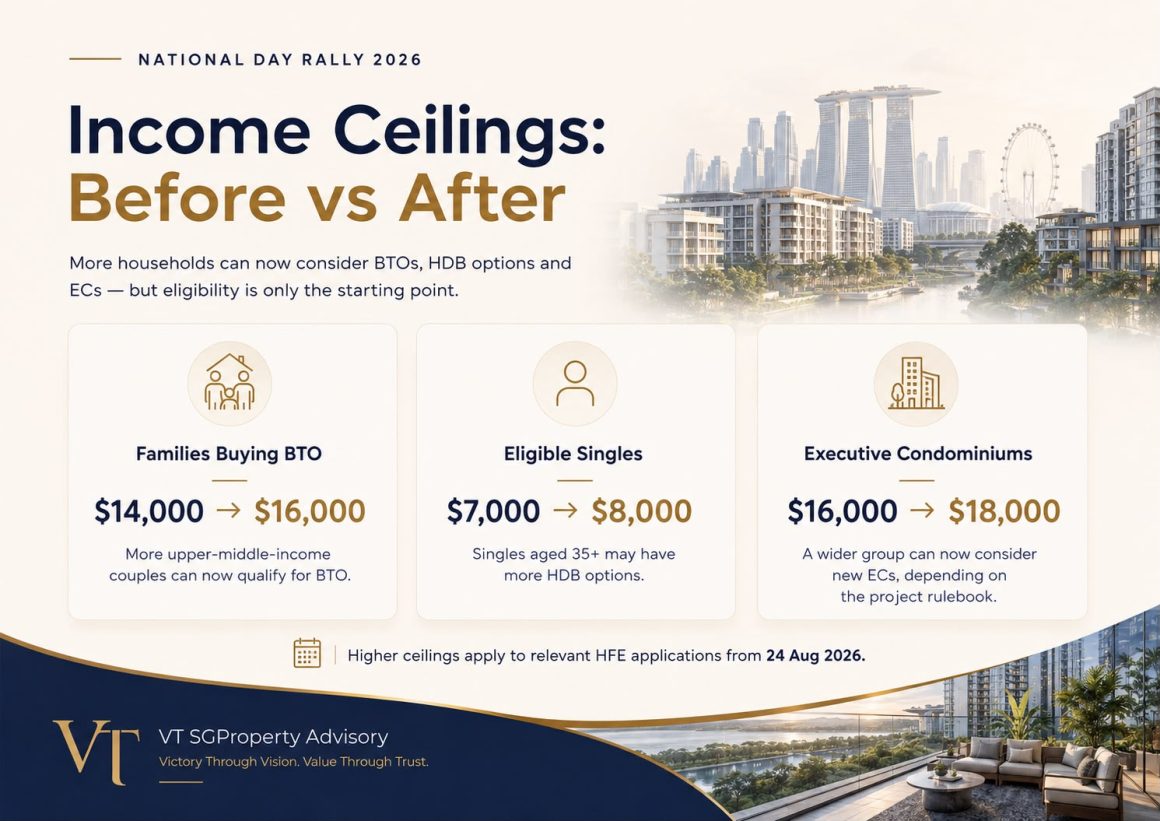
- BTO family income ceiling: $14,000 → $16,000
- Singles’ income ceiling: $7,000 → $8,000
- Executive Condominium income ceiling: $16,000 → $18,000
- Additional BTO/SBF ballot chance for each qualifying Singapore Citizen child
- Further housing support for larger families is being studied
The higher HDB income ceilings apply to eligible buyers applying for an HDB Flat Eligibility (HFE) letter from 24 August 2026. The next BTO exercise has consequently been shifted from October to November 2026, giving buyers time to reassess their eligibility.
But the more important question is not:
“What can I buy now?”
It is:
“Does this new option actually improve my housing plan?”
1. BTO Income Ceiling Rises to $16,000
This is probably the most immediately relevant change for Singapore couples.
The monthly household income ceiling for eligible families buying subsidised HDB flats has increased from $14,000 to $16,000.
That brings a group of upper-middle-income households back into the subsidised housing system.
Previously, a couple earning $14,500 or $15,500 could find themselves in an awkward position.
They might earn too much for a BTO, yet not necessarily feel financially comfortable committing $2 million or more to private property.
That matters particularly today because many Singaporeans are marrying later. By the time they purchase their first home, they may already be further into their careers — but they may also have childcare costs, ageing parents and other financial commitments.
The new ceiling gives these households another choice.
Will Higher Eligibility Push BTO Prices Up?
Not automatically.
HDB BTO pricing is not simply determined by the maximum income of the people applying.
But a higher ceiling does enlarge the eligible applicant pool.
So for particularly attractive launches — strong locations, shorter waiting times, desirable layouts or scarce larger flats — competition could become more intense.
This makes project selection and ballot strategy more important, not less.
What About HDB Resale?
This is where things become more interesting.
Some households who would previously have bought resale because they could not qualify for BTO may now return to the BTO market.
That could remove some demand from resale.
But another group will still choose resale because they value:
immediate occupation, larger layouts, established neighbourhoods, proximity to parents or schools, or simply certainty over waiting several years for construction.
So we do not expect the policy change to lift or depress the entire resale market uniformly.
The demand could increasingly differentiate between ordinary stock and genuinely scarce homes such as:
- Larger 5-room flats
- Executive Apartments and Maisonettes
- Recently MOP-ed flats
- Well-positioned mature-estate flats
- Flats with exceptional views, layouts or accessibility
There is another development worth considering.
From 27 July 2026, the Government removed the 15-month wait-out period for private residential property owners and former owners purchasing a non-subsidised HDB resale flat without an HDB housing loan, subject to the prevailing eligibility conditions.
That potentially adds another group of financially established buyers to parts of the resale market.
What We Would Do as a Buyer
If your household income previously placed you just above the BTO ceiling, do not simply rush back into BTO.
Re-run the entire decision.
Apply for a fresh HFE letter.
Then compare three things:
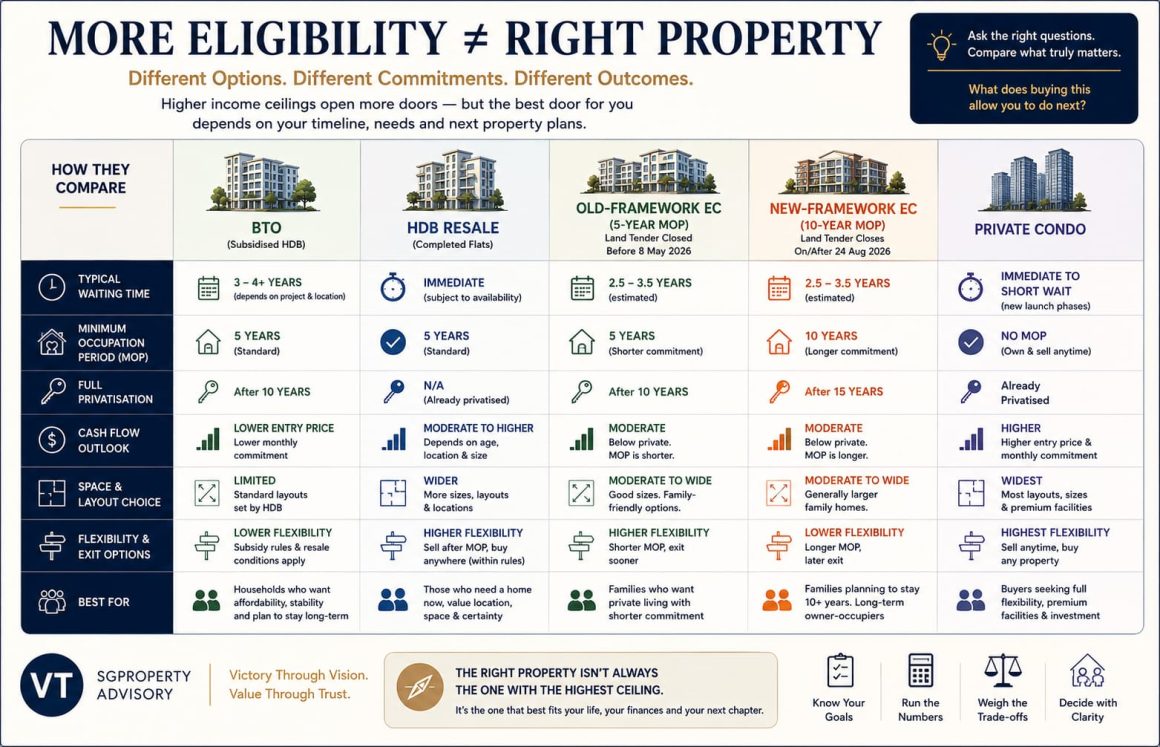
BTO vs resale HDB vs your next realistic private/EC option.
Look beyond purchase price.
Consider:
A) When do you actually need the home?
B) How much cash and CPF do you want left after buying?
C) How much flexibility do you need five years from now?
D) Will the home still work when children arrive or grow older?
E) Are you buying affordability — or merely maximising borrowing capacity?
Being eligible for a $16,000-ceiling BTO does not automatically mean BTO is the right answer.
It simply means you now have another card to play.
2. Singles’ Income Ceiling Rises to $8,000
Singles aged 35 and above also benefit.
The relevant HDB income ceiling has increased from $7,000 to $8,000 for eligible singles.
This matters because some singles earning slightly above the previous ceiling occupied a peculiar middle ground.
They could be earning a respectable salary but still find a private condominium financially uncomfortable — particularly after accounting for mortgage payments, Buyer’s Stamp Duty, maintenance fees and the cash required upfront.
The higher ceiling reopens HDB options for some of these buyers.
Our Advice to Singles: Recompare Everything
Run the numbers again.
Depending on your circumstances, your realistic choices could include:
- 2-room Flexi BTO
- HDB resale
- Compact private condominium
- Continuing to stay with family while preserving or investing your capital
There is no automatic winner.
A $1.3 million private condominium may give you different capital-growth possibilities and flexibility.
But it may also absorb substantially more of your cash flow than a $500,000–$700,000 HDB alternative.
The question is not which one sounds more aspirational.
The question is:
What do you want your property to do for you over the next 5–10 years?
That is a much more useful starting point.
3. EC Income Ceiling Rises to $18,000 — But There Is a Catch
This is probably the most commercially interesting change.
The household income ceiling for new Executive Condominiums will increase from $16,000 to $18,000.
But buyers need to understand something very important:
Not every upcoming EC will enjoy the new $18,000 ceiling.
The $18,000 ceiling applies based on the EC land tender closing date from 24 August 2026, rather than simply when the eventual condominium launches.
That creates two distinct generations of upcoming ECs.
And they should not be confused.
OLD vs NEW EC FRAMEWORK
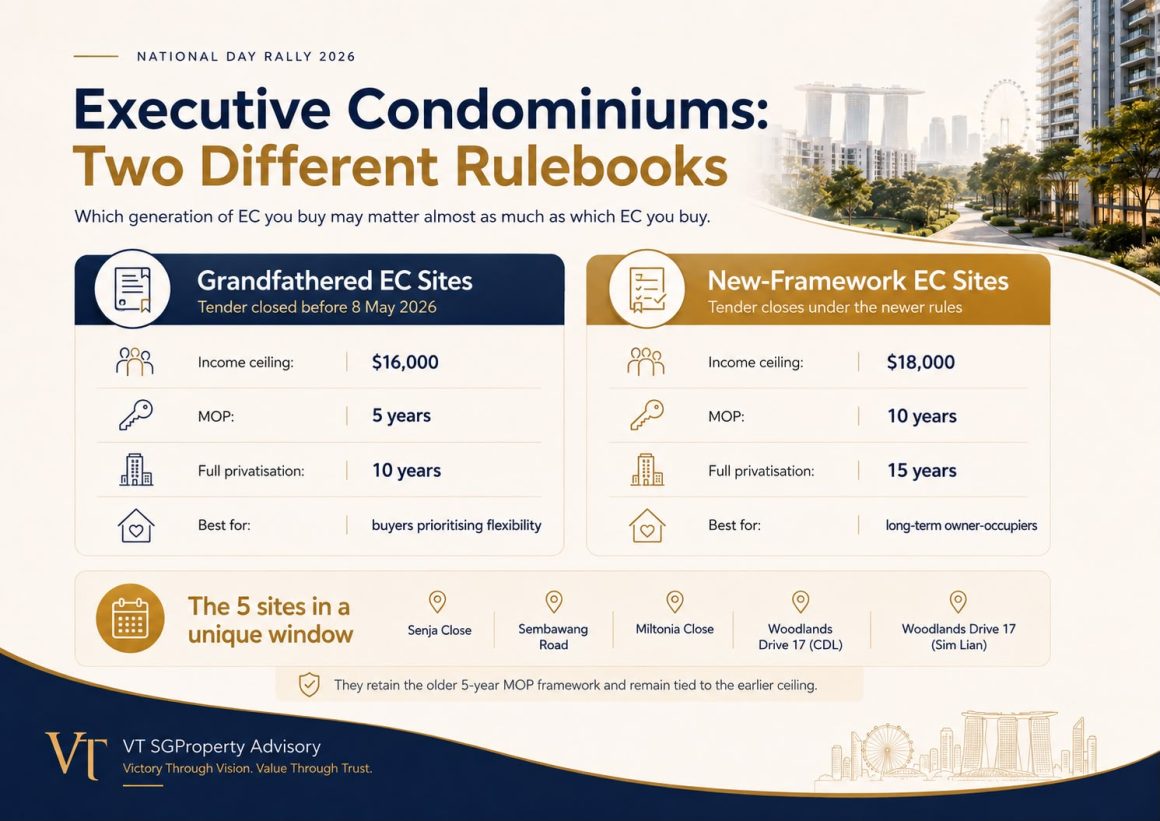
For EC projects where the land tender closed on or after 8 May 2026, the MOP is 10 years instead of five years. Full privatisation consequently comes later as well.
This is a major difference.
The Five EC Sites Sitting in a Unique Window
There are five upcoming EC land parcels that closed before the 8 May 2026 MOP-rule change:
- Senja Close
- Sembawang Road
- Miltonia Close
- Woodlands Drive 17 — CDL site
- Woodlands Drive 17 — Sim Lian site
These projects retain the earlier 5-year MOP / 10-year privatisation framework because their land tenders closed before the new MOP rules took effect.
But because their land tenders also preceded the new income-ceiling cut-off, buyers should not assume the new $18,000 ceiling applies.
That leaves these projects in a rather unusual position:
Shorter MOP — but lower $16,000 income ceiling.
Once this generation is sold, that particular combination may not be repeated.
For households earning below $16,000 who were already considering an EC, that makes these developments worth studying carefully. Not automatically buying.
Studying. Because a favourable policy framework cannot rescue a poor purchase.
Location, unit type, entry price, competing supply and eventual resale demand still matter.
Future ECs: $18,000 Ceiling, But Longer Commitment
Now consider the next generation.
Among the EC GLS sites currently on the Government pipeline are:
A. Canberra Drive — currently open for tender
B. Admiralty Walk — currently open for tender
C. Jurong East Avenue 1 — scheduled for tender launch in December 2026
The 2H2026 Confirmed List provides approximately 735 EC units.
Canberra Drive’s tender, for example, is scheduled to close on 1 October 2026, placing it clearly within the new framework.
These sites will help answer a major question:
How much will developers be prepared to pay for EC land when buyers can earn up to $18,000 — but must potentially commit to a 10-year MOP?
The longer holding period changes the proposition.
A household buying such an EC needs to be comfortable staying for a much longer period.
That could favour:
- Larger family-oriented layouts
- Better storage
- Stronger owner-occupier facilities
- Proximity to schools and transport
- Locations families can genuinely see themselves staying in
The new EC may increasingly become less of a transitional property and more of a long-duration family home.
That is quite a meaningful shift.
Could Old-Framework ECs Become More Valuable?
Possibly. But this needs to be understood carefully.
A 5-year-MOP EC does have significantly more flexibility than a comparable future EC requiring 10 years.
That may increase buyer interest in the grandfathered projects.
Indeed, market analysts have already highlighted the potential for near-term demand to gravitate towards EC projects unaffected by the new restrictions.
But scarcity does not give developers an unlimited pricing cheque.
If a new EC’s price comes too close to a comparable young private condominium, buyers should ask:
What exactly am I receiving in exchange for accepting the EC restrictions?
That comparison may become one of the biggest property conversations of 2027 and 2028.
Before Buying Any EC, Ask These 7 Questions
1. When did the land tender close?
This determines which regulatory framework applies.
2. Is my applicable income ceiling $16,000 or $18,000?
3. Is my MOP five years or ten years?
4. How much am I really saving versus a comparable private condominium?
5. Does that saving compensate me adequately for the restrictions?
6. Can my family genuinely live here for the full holding period?
7. What competing EC, resale condo and private-new-launch supply will exist when I eventually want to sell?
For EC buyers going forward:
Which generation of EC you buy may matter almost as much as which EC you buy.
4. One Additional Ballot Chance for Every Qualifying Child
From the February 2027 sales exercise, first-timer families with children — or expecting children — will receive one additional ballot chance for each Singapore Citizen child aged 18 and below.
The measure applies to both BTO and Sale of Balance Flats applications.
Eligible First-Timer Parents and Married Couples already receive more ballot chances than other first-timer households.
The new policy adds another layer of priority to households with children.
And intuitively, that makes sense.
Once children arrive, housing becomes much less theoretical.
Suddenly:
A) An extra bedroom matters.
B) School location matters.
C) Grandparents living nearby matters.
D) Storage matters.
E) Commuting time matters.
A family that could tolerate a small temporary home for two adults might view the same home very differently with two children.
Should You Wait Until February 2027?
Not necessarily.
If an appropriate BTO is available in November 2026, don’t reject it purely because your ballot odds could improve three months later.
Instead ask:
- How urgently do we need a home?
- How competitive is this particular project?
- Would waiting create a genuinely better housing opportunity?
- Will this flat still work when our children are older?
- Could resale solve the problem faster?
More ballot chances improve probability. They do not guarantee a flat.
5. More Housing Support for Larger Families — But Don’t Price It In Yet
Prime Minister Lawrence Wong also announced that Minister for National Development Chee Hong Tat has been asked to study additional housing support for larger families.
The logic is straightforward.
A larger household often needs a larger home — and larger homes cost more.
But the specific housing support has not yet been announced. We do not currently know:
- the eventual benefit amount?
- the qualifying number of children?
- the applicable income ceiling?
- which flat types will qualify?
- whether resale housing will be included?
- or when the measures will commence?
So do not build today’s property purchase around benefits that have not yet been confirmed.
Treat this as something to monitor.
If space is your main priority today, compare upcoming BTO options with larger resale alternatives such as older 5-room flats, Executive Apartments or Executive Maisonettes.
You may get considerably more physical space.
But factor in:
Remaining lease, Renovation expenditure, Maintenance condition, Financing and Eventual buyer demand.
There is always a trade-off.
The Bigger Story Isn’t Higher Income Ceilings
The obvious interpretation of NDR 2026 is:
More Singaporeans can now buy BTOs and ECs.
We think there is a more useful interpretation.
More Singaporeans now have choices they did not have last week.
And that means choosing correctly becomes more important.
A household earning $15,000 may now be able to choose between:
- BTO
- HDB resale
- Grandfathered EC
- Future EC
- Private property
But these are not interchangeable homes.
Each one creates a very different:
i. Cash-flow profile
ii .Holding period
iii. Lifestyle
iv. Exit strategy
v. Next-property timeline
The biggest mistake would be to interpret increased eligibility as permission to maximise your purchase price.
Housing policy has widened the road.
It hasn’t told you which lane to take.
What Should You Do Now?
If your household income sits anywhere near the old thresholds, this is a good time to reassess your property position.
For buyers targeting the November 2026 BTO exercise, HDB has advised applicants to apply for their HFE letter early and submit the required documents by 25 September 2026. Around 7,960 flats across Bedok, Geylang, Sembawang, Tengah, Toa Payoh and Yishun are expected in the exercise.
Start with:
“Where do I want my family and finances to be five or ten years from now?”
Then work backwards.
Not Sure Which Option Fits You?
Let’s map your new eligibility against your actual property goals — not simply what you now qualify to buy.
Whether you are:
Reconsidering BTO after the new $16,000 ceiling
Deciding between BTO and HDB resale
Comparing one of the grandfathered 5-year-MOP ECs against the future EC framework
Considering whether a private condominium gives you better flexibility
Planning your next move after selling your existing property
Valery and Tiong can walk through the numbers, trade-offs and sequence with you before you commit.
A good property decision should answer:
“What does buying this allow me to do next?”
Victory Through Vision. Value Through Trust.